Conversations In Climate Tech: Has LFP already won the Battery Race?
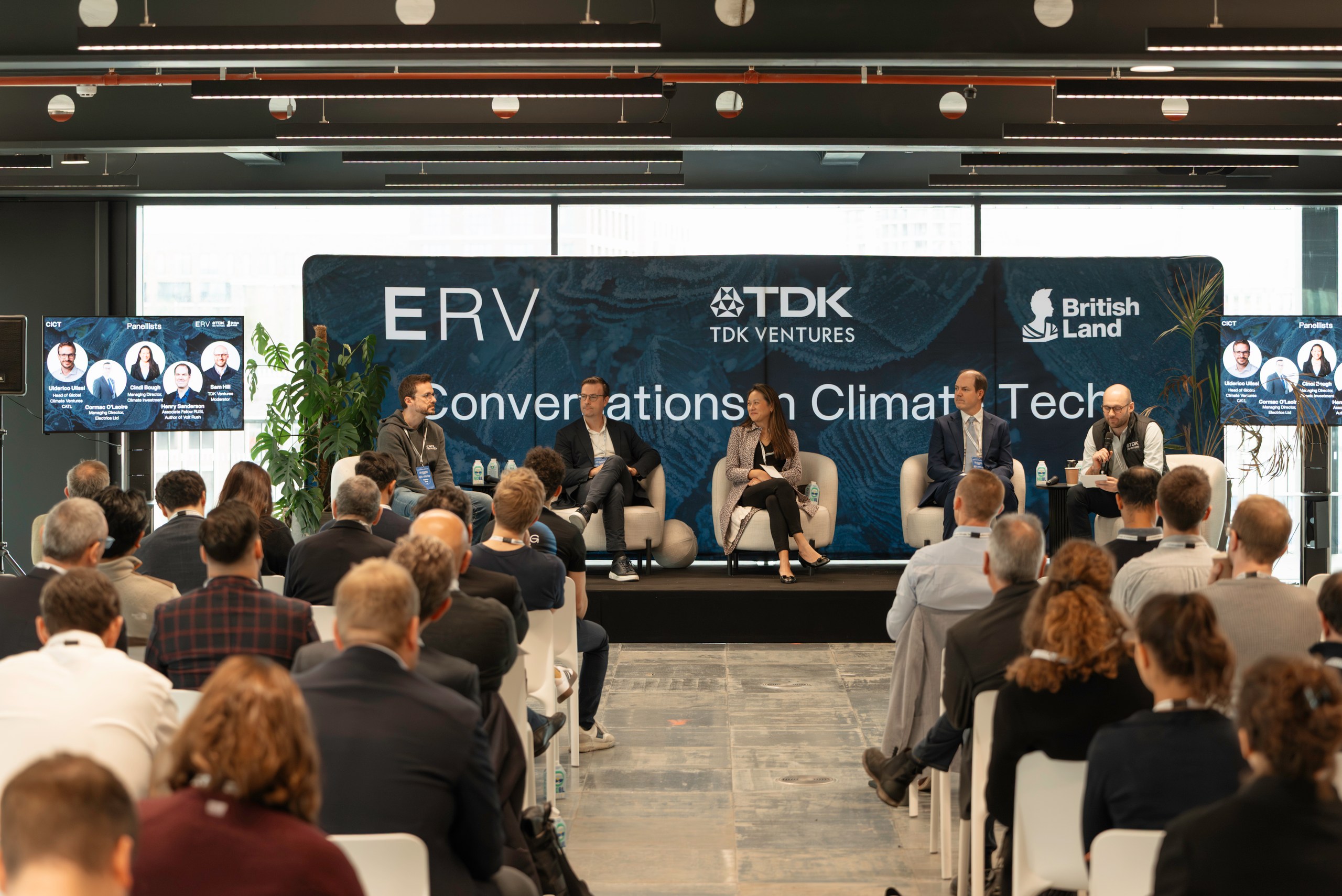
Date: October 7, 2025
Co-hosted by: Energy Revolution Ventures, TDK Ventures, and supported by British Land
Venue: Dock Shed, Canada Water, London
Panelists:
- Cindi Bough – Managing Director, Climate Investment (CI)
- Cormac O’Laoire – Managing Director, Electrios Consultants
- Henry Sanderson – Associate Fellow at RUSI & Author of Volt Rush
- Ulderico Ulissi – Principal & Head of Global Climate Ventures, Contemporary Amperex Technology Co., Limited (CATL)
- Sam Hill – TDK Ventures (Moderator)
5 Key Takeaways:
1. LFP’s success is structural but not permanent
LFP has achieved dominance because of its chemistry’s intrinsic scalability, safety, and cost efficiency rather than superior performance. It is the industrial “workhorse,” not the technological endpoint. Its rise reflects how manufacturing integration, not pure innovation, defines market leadership—a model pioneered and perfected in China.
2. The sodium-ion vs. LFP race will define the next decade
Sodium-ion batteries are LFP’s closest and most credible challenger. They share similar safety and material advantages while offering better cold-temperature performance and freedom from lithium supply constraints. However, the absence of a standardised chemistry and the fact that all sodium-ion cathode manufacturing is currently in China limit near-term global adoption. Expect coexistence, not displacement: LFP will remain the benchmark for reliability and sodium-ion the pathway to diversification.
3. Industrial symbiosis is the hidden engine of cost advantage
China’s cost leadership in LFP is not just scale—it is industrial ingenuity. The integration of the titanium dioxide pigment industry into the LFP supply chain, where waste ferrous sulfate becomes a cathode precursor, exemplifies how industrial ecosystems can transform waste into competitive advantage. This deep interconnection between chemical sectors is an overlooked driver of China’s enduring edge.
4. The next breakthroughs will come from systems, not cells
Battery innovation is shifting from chemistry-level competition to system-level optimisation. Hybrid architectures that combine LFP arrays with compressed-air or flow systems already extend discharge durations to multiple days. Similarly, cell-to-pack integration and decarbonised graphite production are reshaping cost and sustainability profiles faster than any new chemistry can.
5. The global battery market will be chemistry-diverse by 2035
The industry is moving from competition to orchestration. By 2035, LFP and sodium-ion are expected to dominate mass production, NMC and solid-state will serve high-performance markets, and zinc and redox flow systems will anchor long-duration storage. The defining innovation will not be a single chemistry breakthrough but a multi-technology ecosystem that balances cost, performance, and resilience across regions and applications.
Panel Summary:
Battery Landscape
The global battery market now exceeds 100 billion dollars and continues to expand as electrification moves from vehicles into grids, data infrastructure, and heavy industry. Within this dynamic landscape, lithium iron phosphate (LFP) has achieved a dominant position as the chemistry of choice for mass-scale deployment. Yet its success has also framed a larger conversation about what comes next.
The consensus emerging from the discussion is that the future will be multi-chemical rather than monopolistic. Each battery chemistry (LFP, sodium-ion, NMC, zinc-ion, redox flow, and solid-state) brings a distinct performance envelope that aligns with specific use cases. LFP may lead on cost, safety, and reliability, but competing chemistries are already advancing in power density, cold-temperature performance, and duration flexibility. The energy storage ecosystem is no longer defined by a single technology curve but by a complex interplay of material science, industrial strategy, and regional resource advantage.
Battery Technologies, Innovation, and Chemistries
The discussion highlighted that LFP’s dominance is pragmatic rather than absolute. Its strength lies in stability and scalability, not in peak performance. LFP cells have an energy density of around 160 Wh/kg, compared to over 250 Wh/kg for NMC, and far below what is expected from solid-state lithium-metal cells under development. This gap limits LFP’s use in aviation, robotics, and long-haul transport, where weight and volume remain critical.
By contrast, zinc-ion batteries can sustain charge and discharge rates exceeding 20C, making them uniquely suited to high-power and high-frequency environments such as defense, robotics, and data centers. Redox flow batteries, though costly, offer remarkable stability for long-duration energy storage and can maintain performance beyond 10 hours of continuous discharge, where lithium-based systems reach thermodynamic limits.
The most intense comparison, however, lies between LFP and sodium-ion. Both rely on abundant, non-toxic elements and target similar markets in mobility and stationary storage. Sodium-ion has significant theoretical and geopolitical advantages: sodium is cheap, plentiful, and globally distributed. It performs better in sub-zero temperatures and decouples energy security from lithium supply chains. However, the chemistry is fragmented, with several competing approaches to cathode and electrolyte formulation. This lack of consensus has slowed industrial standardisation and commercial scale-up. Currently, all large-scale sodium-ion cathode manufacturing remains in China, giving that ecosystem a decisive early lead.
From a system perspective, sodium-ion could eventually undercut LFP on cost per kilowatt-hour, particularly for stationary storage, but not yet on volumetric efficiency. LFP’s well-established manufacturing base, proven cycle life exceeding 10,000 cycles, and optimised pack design give it a near-term advantage. The likely outcome is coexistence rather than displacement, with sodium-ion serving as a flexible, low-cost complement and LFP maintaining its role as the global workhorse chemistry.
Materials (Metals, Minerals, and Components)
Material science remains the defining constraint and differentiator across chemistries. LFP’s reliance on lithium, iron, and phosphate gives it structural resilience against price shocks, while its connection to China’s titanium dioxide industry offers a unique cost advantage. Ferrous sulfate, a by-product of titanium dioxide production, is converted into a precursor for LFP cathodes—an industrial symbiosis that dramatically lowers cost and waste. This linkage demonstrates how cross-sector coordination, rather than chemistry alone, drives competitiveness.
NMC chemistries remain dependent on nickel and cobalt, whose markets are volatile and geographically concentrated in the Democratic Republic of Congo and Indonesia. These materials bring higher energy density but also higher ethical and environmental costs. Sodium-ion and zinc-ion sidestep these issues entirely, relying on abundant elements with lower extraction impact. However, the anode side presents a challenge for nearly all current chemistries. More than 90 percent of global graphite, both natural and synthetic, is produced in China, often using coal-fired energy. This dependence adds hidden carbon intensity even to “green” batteries and will be a decisive area for innovation.
Supply Chain and Manufacturing
China’s command of the global supply chain extends across the full value chain—mining, refining, cathode and anode production, and cell assembly. This dominance has enabled extraordinary economies of scale and price compression, but at the cost of strategic fragility elsewhere. The concentration of cathode and anode materials, particularly in coal-powered regions, means the carbon footprint of a supposedly clean battery is still heavily tied to fossil energy.
Western economies face the dual challenge of cost and capability. Efforts to localise production, particularly in Europe and North America, are underway but remain nascent. Sodium-ion and zinc-ion present potential pathways for diversification, as they can utilise existing manufacturing equipment with limited adaptation. Achieving regional resilience will depend on building refining capacity, developing new graphite substitutes, and leveraging waste-to-value pathways similar to China’s titanium dioxide integration.
Market Dynamics and Use Cases
Battery selection is increasingly determined by application rather than chemistry loyalty. LFP dominates mass-market EVs, buses, and stationary storage due to its safety, cost, and durability. NMC continues to serve premium vehicles and aerospace applications where energy density outweighs cost concerns. Sodium-ion is positioned to become the chemistry of choice for shorter-range mobility and cold-climate energy storage, while zinc-ion and redox flow systems are emerging as the preferred options for high-power and long-duration applications respectively.
In energy infrastructure, mechanical and electrochemical hybrids are becoming more common. Grid-scale projects in China already combine LFP arrays with compressed-air systems, achieving multi-day discharge windows that no single battery chemistry can yet deliver economically. This hybridisation trend illustrates the sector’s transition from chemistry-centric competition to system-level integration, where multiple storage technologies operate collaboratively rather than competitively.
Investment and Industry Outlook
Investment activity is shifting away from speculative chemistry bets toward manufacturability, supply chain efficiency, and integration economics. Technologies that fit within existing production frameworks or can demonstrate bankable reliability attract the most capital. Sodium-ion is seen as the next major industrial platform, with China scaling production capacity aggressively, while Western investors remain cautious due to fragmented IP and limited pilot success.
Recycling and circularity are becoming critical evaluation criteria. While NMC retains material recovery value, LFP’s recycling economics remain weak due to its low metal value. This disparity may motivate future policy interventions or incentives to close the loop. There is also growing recognition that breakthroughs may come not from novel materials but from process innovation, such as decarbonised graphite production, solid-state electrolyte deposition, and cell-to-pack structural efficiency.
By 2035
By 2035, the global battery market will be defined by coexistence and complementarity rather than a single dominant chemistry. LFP and sodium-ion are projected to account for the majority of global production volume, while NMC, solid-state, and zinc-based chemistries will occupy strategic niches in high-energy, high-power, and long-duration applications.
The path forward will depend on material diversification, low-carbon manufacturing, and collaborative supply-chain design. LFP will remain the benchmark for scalable and affordable storage, but its limitations in energy density, recyclability, and temperature resilience leave ample room for innovation. Sodium-ion stands as its closest challenger, poised to expand where lithium faces scarcity or cost pressure, while mechanical and flow systems will capture the frontier of multi-day energy storage.
The discussion closed on a shared recognition that the global energy transition will be battery-led but chemistry-diverse. Each innovation—from ferrous sulphate reuse to high-rate zinc-ion designs—represents a building block in a rapidly evolving ecosystem. The next decade will not be about choosing a single winner but about orchestrating multiple solutions toward one objective: resilient, sustainable, and universally accessible energy storage.